The state estimates nearly 140,000 HIP members could qualify for exemptions and physicians may play an important role in documenting medical necessity.
Indiana's Family and Social Services Administration (FSSA) has released new medical frailty criteria that will help determine which Healthy Indiana Plan (HIP) members are exempt from federal Medicaid work requirements beginning Jan. 1, 2027.
The new framework, presented during FSSA's Oct. 27 quarterly financial review, establishes a three-tiered assessment process that considers diagnoses, treatment history and functional limitations.
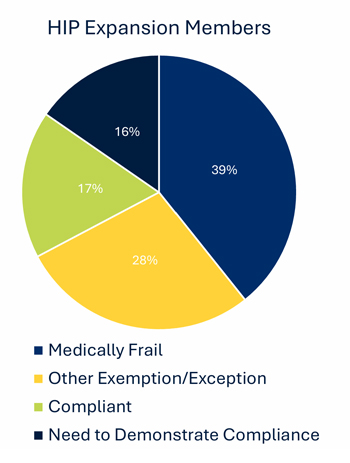
According to FSSA, approximately 139,300 HIP expansion members have been identified as medically frail, representing 39% of the state's 354,606 expansion members as of Sept. 30.
Under the new requirements, affected Medicaid members who do not qualify for an exemption must demonstrate 80 hours per month of qualifying activities, including employment, education, participation in a work program or community service. Members may also demonstrate compliance through monthly employment income equivalent to 80 hours at the federal minimum wage.
The federal framework narrows medical frailty to five categories:
blindness or disability, disabling mental disorders, physical or developmental disabilities, substance use disorders, and
serious or complex medical conditions.
A key consideration is whether a medical condition significantly impairs an individual's ability to satisfy community engagement requirements.
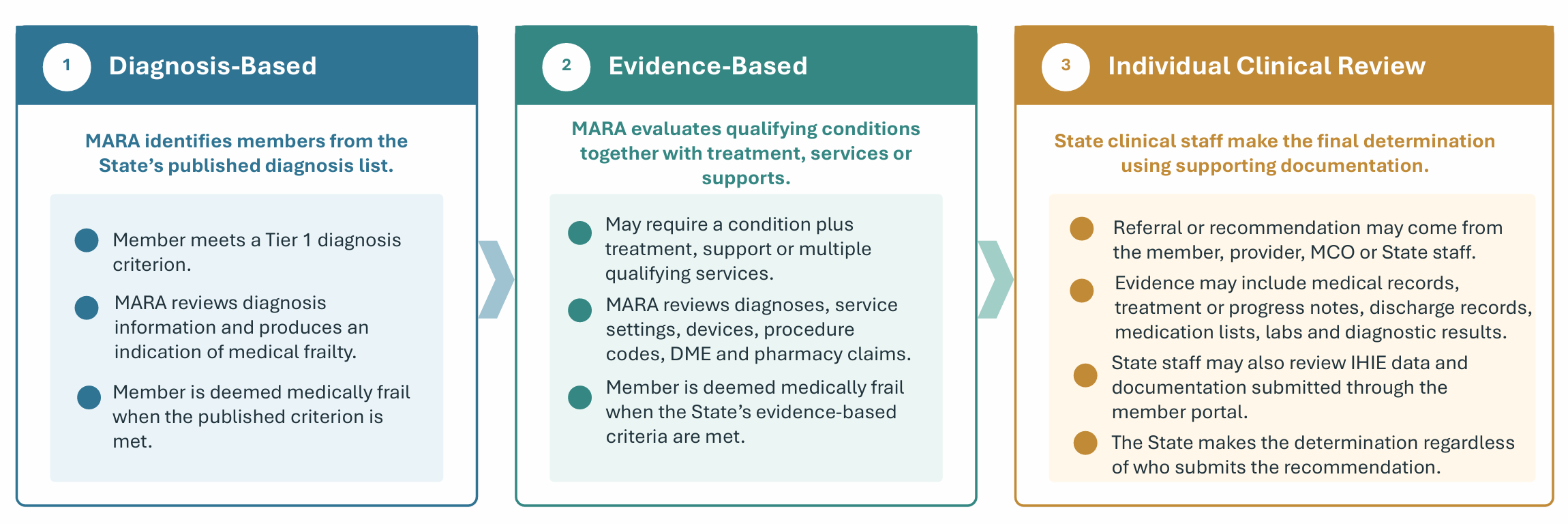
Indiana will use a three-tiered assessment system supported by a claims-based evaluation tool known as MARA.
Tier 1: Diagnosis-based determination. Certain ICD-10 diagnoses may independently establish medical frailty. These include selected severe disabilities, substance use disorders and serious or complex medical conditions.
Tier 2: Evidence-based determination. Patients may qualify based on a combination of diagnoses and documented treatments, medications, services or medical supports. The system will evaluate claims data, including procedures, durable medical equipment and pharmacy records.
Tier 3: Individual clinical review. Patients who do not meet the first two tiers may undergo an individualized review by state clinical staff. Physicians, managed care organizations, patients and state staff may recommend a review.
Supporting documentation may include medical records, treatment notes, discharge summaries, medication lists, laboratory results and diagnostic findings.
The state will make the final medical frailty determination.
What physicians should know
The new process could place additional importance on clinical documentation, particularly for patients with complex chronic conditions who may not qualify through an automatic diagnosis-based determination.
Physicians caring for HIP members should be aware of the following:
- Documentation may be critical. Medical records describing functional limitations, ongoing treatment and the impact of a condition on daily activities may support a medical frailty review.
- Diagnosis alone may not be sufficient. Some conditions will require additional evidence of treatment, services or functional impairment.
- Physicians may recommend a review. Providers can initiate a recommendation for individualized assessment when claims data do not adequately reflect a patient's medical circumstances.
- Exemptions are time-limited. FSSA indicates that confirmed medical frailty will provide a six-month exclusion from community engagement requirements.
The new framework also changes the purpose of medical frailty determinations. Through 2026, Indiana uses medical frailty to determine access to the broader HIP State Plan benefit package. Beginning in 2027, the determination will instead establish whether an individual is excluded from federal community engagement requirements.
FSSA's presentation indicates that all HIP members will receive State Plan benefits under the new framework.
As Indiana prepares to implement the requirements, physicians may have an important role in helping ensure patients with significant medical limitations are appropriately evaluated and do not experience avoidable interruptions in coverage.
Additional information
FSSA's quarterly presentation includes details about the medical frailty framework (slides 141–149), the three-tiered assessment process and the HIP population potentially affected by the new requirements.